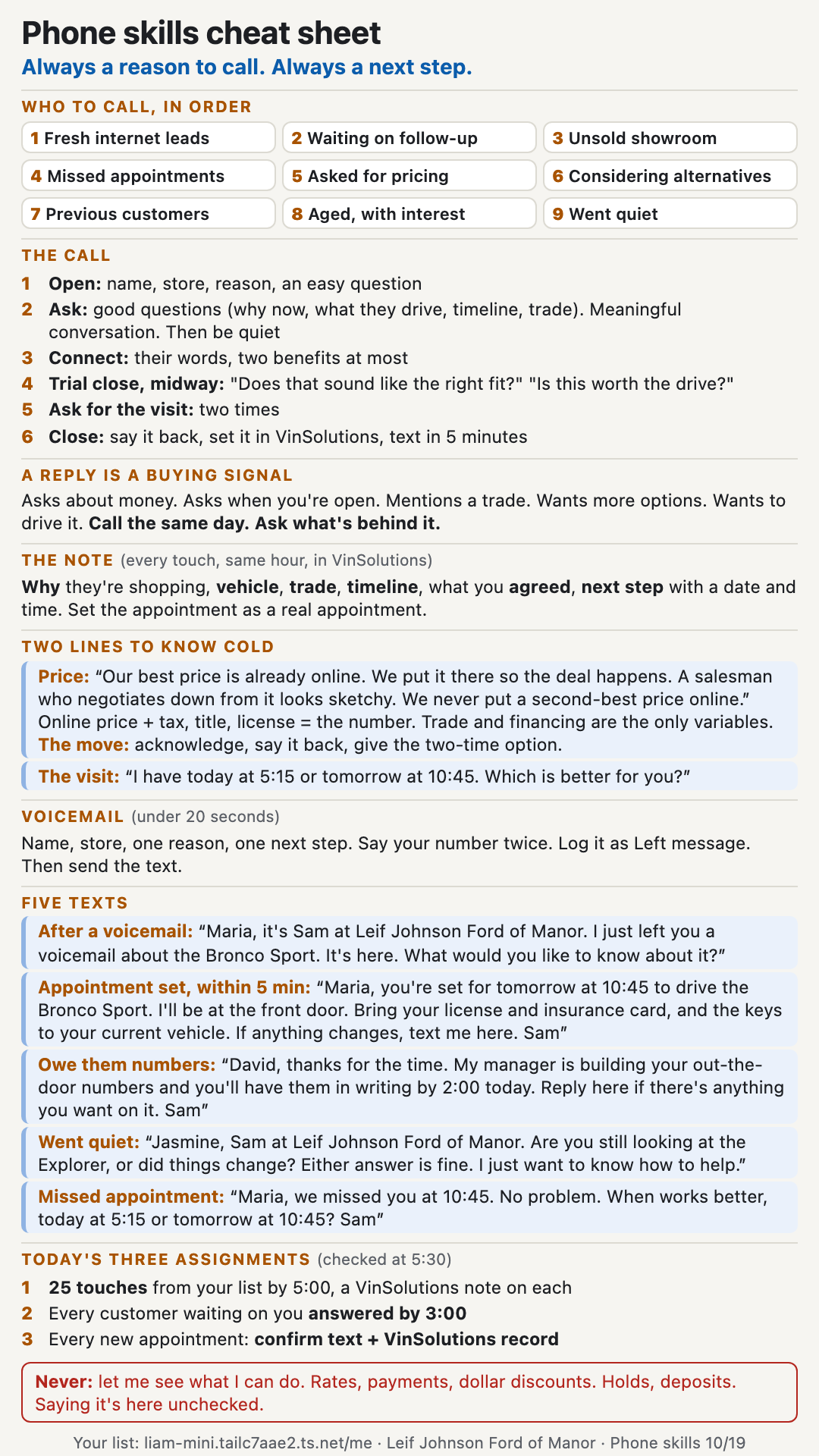
For the manager running the 1:00 PM session. 30 minutes, minute by minute. Version 3.1 (Will's 12:30 edits): video 1 is gone (slide 4 is now a text slide), two discussion prompts follow the two videos, the best-price slide follows Will's rule. Version 3 added buying signals, trial close, VinSolutions notes, ownership, a knowledge check and three assignments.
Session at a glance. 30 minutes, Monday 10/19 at 1:00 PM, on the sales floor. All salespeople. 21 slides, two short videos (about 2.5 minutes of video in all), one round of role-play, a five-question knowledge check and three assignments due today. Suggested: Will or Gary runs it and Matt, Oscar and Eric run the role-play for their pods. Short on time? The 25-minute cut is under the plan. Record the session for the library (it is on the morning brief).
The point of today. We generate engagement and fail to convert it into opportunities. Customers answer our texts. They say yes, ok, what is the down payment, are you open Sundays. Then nobody calls. This session fixes one thing: a reply, a buying signal or a ringing phone ends in a visit on the calendar, a note in VinSolutions, and a name on it. Everything on the slides serves that.
The numbers behind slide 3 (say them plain, use no names)
These are store-level counts from this morning. They are the facts that open the session. Do not name a rep, a pod or a customer when you use them. Slide 3 shows only the first two. The other three are off the slide on purpose (Will 10/19); they stay here as backup facts if someone asks. Do not put them on the screen.
On the slide
What it means
Source and time
At 12:45
52 of 125, 12 selling days left
52 deliveries so far (23 new, 29 used) against the store goal of 125. That is 73 short with 12 selling days left counting today: 6.1 a day needed, 3.5 a day so far. 4.4 a day over the last 5 selling days.
Holds all day. Today's deliveries post tomorrow (next count Tuesday 7:22 AM).
41 of 64, shown then bought
Of the 64 appointments that showed Oct 1 to 19, 41 bought (64%). When they come, we sell them. (Buyer matched by VinSolutions sold GCID or Axcessa name.)
Real appointments on the book for the rest of this week: Tue 10/20 10:30 AM and Thu 10/22 4:30 PM. The pace page counted 3 because it included an old VinSolutions record dated today with no rep and no lead row (an old record last touched in 2015). The morning brief does not count it either.
data/store/vs-appointments.json on the Mini, updated Mon 10/19 9:32 AM. Pace page: october-pace-2026-10-19.html, section 7.
Re-read it. If reps set more this morning, say the new number. That is good news, not a problem. Never round up.
6, replies unanswered (off the slide)
Customers who wrote back and no person has answered. The oldest of the six replied on 9/12, 37 days ago. The three pod plans at 8:33 AM list 11 (4 + 2 + 5): a wider cut that includes replies our auto-text answered. Same problem either way.
Re-read it. Reply now cards on My List. If it is lower, say who cleared it (the room, not a name).
0, hit 25 Fri or Sat (off the slide)
No rep in the three pods hit their 25 on Friday or on Saturday (0 of 2 days for all 12 reps with a list). "Hit" means finishing the shorter of 25 and the morning list: a call, text or email VinSolutions shows on each lead, or the lead closed. Raw touches are a different count: one rep logged more than 80 touches on Saturday and still did not hit, because the recap counts the list.
manager-debrief pages for the three pods, 10/19 8:33 AM. Rule: scripts/lib/rep-streaks.ts.
History. Does not change.
More facts to use out loud (all store-level, all from the same sources):
Saturday 10/17, all three pods: 289 person touches (141 + 21 + 127), 44 customer replies (25 + 4 + 15), 7 appointments shown, 0 new appointments set, 6 units sold. A lot of activity, no new visits booked. Source: the three pod plans, 8:33 AM.
85 active leads are past 72 open-store hours with no person touch (27 + 29 + 29). The machine texted them. No human did. Source: pod plans 8:33 AM.
34 stranded leads were proposed to the pods this morning (18 + 4 + 12): leads sitting on the sending login or on a part-time seller with no VinSolutions login, so no rep was working them. Source: pod plans 8:33 AM.
58% vs 17%. People who came in on an appointment bought the same day 58% of the time (39 of 67). Walk-ins, drive-bys and referrals bought 17% (8 of 48). 115 showroom visits in 15 selling days. Source: october-pace section 5, Desk Log 10/1 to 10/17.
Traffic is not the problem. About 120 leads a week (116, 136, 131, 112, 127, 126, 118 since Aug 31). 103 appointments set in 15 days, 64 shown, 22 missed, 16 cancelled. Source: october-pace sections 5.
Short replies sit. In one pod's best-shot list this morning, 4 of the 8 customers last wrote "Yes" or "Ok". Somebody has to find out what they said yes to. Source: manager-debrief pod plan, 8:33 AM, the "Last said" column.
11 of the 52 October deliveries were never marked sold in VinSolutions. Source: october-pace section 1. That is a documentation gap.
Before 1:00 (15 minutes)
Slide 3 shows two numbers (52 of 125, 41 of 64) and neither moves during the day. If you are asked about this week's appointments or waiting replies, re-read them at 12:45 from the backup table above. A reminder text goes to Matt, Oscar, Eric and Will at 12:45 PM. The team text with the handout link goes at 1:00 PM.
Open the deck full screen on the TV: deck.html. Press F for full screen. Arrow keys move through it. On a video slide, Space plays and pauses.
Print the scorecard (one per pair per round), the role-play cards (one set per pod) and the tracking table at the bottom of the assignments section (one per pod manager). All print cleanly from the browser.
Pick one pod manager to play the customer in the opener demo.
Decide who covers the floor for walk-ins during the 30 minutes.
Read "Older lines we do not use today" below so you do not repeat an old line by habit.
Play the first few seconds of each video on the TV (slides 8 and 14) so you know the sound works. They load when you reach the slide.
Minute-by-minute plan (30 minutes)
Start
Min
Segment
Slides
What you do
0:00
1
Open
1-2
Say why we call, in Will's voice (notes, slide 2). The bot keeps them warm. The call, the video and the appointment are yours.
0:01
1
The gap
3
Read the two numbers slowly. Ask: which of these can you change by 5:00?
0:02
1
How it all works
4
Text slide, no video. Read it: the bot answers in minutes and keeps them warm. You call, you video, you set the appointment.
0:03
1
Who to call, prepare
5-6
Read the nine fast. Show where the Call list sits on My List. Sixty seconds, then dial. No reason, no call.
0:04
2
Buying signals
7
Read the five. Give two real replies from this week. Ask: which one have you seen and not called?
0:06
3
Video 2: a good call
8
Play the video (1:17), then 60 seconds of talk: What worked? Name two things. Cue below in the notes for slide 8.
0:09
2
Open, ask, use their words
9-11
Read the weak opener, then the strong one. Good questions, meaningful conversation, then be quiet: have the room ask three questions to a neighbor. Then use their words. No discounts, no dollar figures.
0:11
2
Trial close
12
Say the two trial closes (Does that sound like the right fit? Is this worth the drive?). Two reps say one in their own words. Then the two branches: yes, or unsure.
0:13
1
Objections: A.I.M. and the four moves
13
Read A.I.M. Walk the four moves on I'm just looking. The other seven are in the guide and on the handout.
0:14
3
Video 3: what's your best price?
14
Play the video (1:16), then 60 seconds of talk: What did he say first? What did he never do? Cue below in the notes for slide 14.
0:17
1
The best-price rule
15
You say the rule. The room says the formula and the move back, once.
0:18
1
Set the appointment
16
Five steps. Two quarter-hour times. The Appt button does not set it in VinSolutions.
0:19
1
Log it
17
The note and the appointment record. Read one good note and one poor note out loud.
0:20
1
Own it
18
After the bot, a person. Same-day answer, voicemail then text, yours until sold, lost or handed off.
0:21
6
Role-play
19
Pairs inside the pod. 2 minutes on the call (ask, trial close, two times), the caller reads the note aloud, 1 minute of feedback with the scorecard, then swap. Pod managers sit with one pair, then the other.
0:27
2
Knowledge check
20
Five questions to a neighbor (45 seconds), then you read the answers (75 seconds). Answers in the key below.
0:29
1
Assignments
21
Read the three. Each rep says their first call out loud. Show the handout. The handout link goes to the team by text at 1:00 PM.
25-minute cut. Skip slides 5-6 (the room reads the nine on the handout) and run one round of role-play (3 minutes: one pair does the full call, the rest watch). Ask only questions 1, 2 and 5 of the knowledge check in the room and ask 3 and 4 on Friday. That is 25 minutes. The two videos (with their 60-second talk), the gap, buying signals, trial close, the note and the assignments all stay.
Slide notes (what is behind each slide)
The slides carry one idea each, 26 words or fewer. The detail lives here. Each slide has what to say, what to do and what to watch for. The two video cues (slides 8 and 14) are the "play the video, then ask" boxes. The new slides in this version are 3, 7, 12, 17 and 20; slides 15, 18, 19 and 21 changed.
Slide 1: Title (0:00)
One sentence to open: every reply gets a person, every call ends with a next step, every touch gets a note. Today is 30 minutes, two short videos, a round of role-play, five questions and three assignments.
Slide 2: Why we call. (1 min with slide 1)
Say this in Will's voice (your own words are fine):
Here is how this works. Our machine answers every internet lead within minutes. It keeps the customer warm with texts and emails. That is the bot's job. It does not get tired and it does not forget a lead. But nobody buys a truck from a text. Your job is the call, the video and the appointment. Your list on your phone shows who is warm right now. Your 25 a day is how we win October.
The machine does not call. It cannot hear someone hesitate, or a kid in the background.
Every internet lead gets your personal video and your call attempts. The machine's text does not replace either one.
No human touch in 72 hours and a manager can reassign the lead. Machine texts do not count.
A call counts toward your 25 only when it is logged in VinSolutions: Left message, No answer, or the CallRevu link.
Goal for today: every call ends with a next step. An appointment, a callback time, or a written reason it did not happen.
Slide 3: We get the reply. We miss the follow-up. (2 min)
Say this (your own words are fine):
Here is where October stands. We are at 52 with 12 selling days left. The goal is 125. That is about 6 a day and we are running 3.5. I am not here to talk about leads. Leads are steady, about 120 a week. We get the reply. A customer texts back, the machine answers, the customer says yes or ok. Then it sits. Look at what the numbers say. Of the 64 people who showed for an appointment this month, 41 bought. When they come, we sell them. This is not a lead problem. It is a follow-up problem. The next 30 minutes is how we turn a reply into a visit.
Do this: read the two tiles slowly. Then ask: Which of these can you change by 5:00 today?
Land it: the reply is the easy part. The follow-up is ours.
Add one number if you have the room: Saturday had 289 person touches and 44 customer replies across the three pods, and 0 new appointments set. Activity is there. Visits booked are not.
Sources for every number are in the table at the top of this guide. Re-read the two live ones at 12:45.
Do not name a rep, a pod or a customer. Do not compare pods. Say "one pod" or "a customer".
Slide 4: How it all works. (1 min)
Text slide, no video (Will 10/19). Read it: the bot answers in minutes and keeps them warm. You call, you video, you set the appointment.
Land it: the bot keeps them warm. The call, the video and the appointment are yours.
The point of the slide: the bot answers a new lead in minutes, never tires, never forgets a lead, but cannot shake a hand. Your job: the call, the video and the appointment. Your list on your phone. Every call has a reason (they asked, something changed, or one that fits came in). 25 a day is how we win October.
If a rep asks what is a good reason to call: they asked about it, you walked it, you owe them an answer, or a better match arrived. Just checking in is not a reason.
Slide 5: Nine groups. In this order. (1 min with slide 6)
Closest to the door first. Someone who raised a hand today beats someone who went quiet in September.
Why each one: 1 They raised a hand today, speed wins. 2 They already asked, every hour hurts. 3 They were here and left, still warm tonight. 4 They meant to come, rebook the same day. 5 Asking for numbers is a buying signal. 6 They are shopping, reach them before they decide. 7 Easiest yes, they already trust us. 8 They showed interest once, a real reason can wake it. 9 Quiet is not no.
Open My List on your phone: liam-mini.tailc7aae2.ts.net/me. The Call list is at the top with Today's 25. Below it the cards sit in Do now, Today and Watch. Point to where each of the nine lives (table "Who to call: the order and where it lives" at the bottom of this guide).
Ask Manor (the bubble on My List): type Who's my best shot today? It ranks active customers and shows the top 5 with a reason and a link. It scores customers who wrote back in the last 7 days, have an appointment, are waiting on us, came in under 14 days ago, and want a vehicle that is in stock. A tiebreaker, not a replacement for the order.
Pod managers see the whole pod's list. Reps see their own.
Slide 6: Sixty seconds. Then dial.
Sixty seconds, not ten minutes. Read the notes, check the vehicle, know what you owe them.
The full check: History (what happened before). Last conversation (what they said, what we said back). Vehicle (check it is still here today before you say it is). Inventory (two backups ready). Trade (keep or sell, owe anything). Objections (price, timing, a spouse, another dealer). Commitments (numbers, a video, a callback: check your Promise cards).
Good one-sentence reasons: they asked about it today. You walked the vehicle and have something real to say. You owe them numbers, a video or an answer. A better match arrived. Their appointment, or the one they missed. They visited and left.
If the notes say bought elsewhere, lost with a reason, or do not contact: do not call. Tell your manager.
Slide 7: A reply is a buying signal. (2 min)
Say this:
A reply is a customer raising a hand. The bot can answer it. Only a person can find out what it means. Here are five things customers say or do that tell you they are closer than you think. When you see one, call the same day and ask one question.
Signal
Real replies from the pod plans (no names)
What it means
Your one question
Asks about money
"What is the down payment and the cost of each month?" (new lead, Saturday afternoon). "...financing with 20 down" (Wednesday).
They are picturing owning it.
"Happy to get that built right. Are you trading something in?" The desk builds the out-the-door number. You never quote a payment or a rate.
Asks when you're open
"Are you open on Sundays?" (Thursday evening. The reply was held for a person and expired, so it sat over the weekend.)
They are planning a visit.
"We're closed Sundays. I have today at 5:15 or tomorrow at 10:45. Which is better?"
Mentions a trade
"No but I have it." "No, I do not have a trade-in." (both answers to a trade question)
They are answering your questions. They are in the conversation.
"About how many miles? Do you owe anything on it?"
Wants more options
"Yes if you could find me one in that same price range" (Oct 12, still no person answer a week later). "...more options I'm sure I'm missing besides the ones you mentioned" (Thursday).
They are asking you to work for them.
"What matters most on the next one? Let me check what we have that fits and I'll call you by 3:00."
Wants to drive it
A customer asked about setting up a test drive (Thursday).
The strongest signal there is.
"Let's get you behind the wheel. I have today at 5:15 or tomorrow at 10:45."
Two more to mention: a customer brings in a spouse or someone else ("Is Mark part of the decision?" in the examples page), and a short reply like Yes or Ok. A short reply is a signal that something was agreed to. Read the thread, then call and say what they agreed to. In one pod's best-shot list this morning, 4 of the 8 customers last wrote Yes or Ok.
What to do with any signal: read the thread, call the same day (a text alone is not follow-up), ask the one question, log it (slide 17).
Poor vs good. Poor: the reply "Are you open on Sundays?" waits from Thursday to Monday with no person. Good: a person calls within the hour: It's Sam at Leif Johnson Ford of Manor. We're closed Sundays, but I'm here Saturday until 7. Are you looking at something specific?
If they said stop, they mean stop. Log it. Do not call or text.
Ask the room: Which of these have you seen on your list this week and not called?
Slide 8: A good call. (3 min)
Play the video (1:17), then 60 seconds of talk: What worked? Name two things. Take answers from the room. Good answers: he gave the reason first, he asked one question tied to the answer, he offered two times, he confirmed it.
Land it: the reason first, one question tied to the answer, two times, confirm and send the address.
Michael asked about a Bronco Sport on Saturday, and the bot has texted him twice. Now Reid calls. The video points out three things: open with the reason, one question tied to the answer, two times then confirm and send the address.
The video says 5:30 and Wednesday at 6:00. Say quarter-hour times out loud when you debrief (5:15, 10:45). They sound like a real plan.
Slide 9: Open with the reason. (2 min with slides 10-11)
Four parts: who you are (your name, Leif Johnson Ford of Manor), why you are calling (what they did, or what you did), one useful thing, an easy question (do you have two minutes?).
Say it in your own words. A script read out loud sounds like a script. Slower than you think. Calm and certain beats fast and friendly.
Leave out: How are you today. Just checking in. Did you get my email. My friend. Buddy. No fake familiarity.
Do the demo: read the weak opener, then the strong one. Weak: Hi, is this Maria? This is Sam from Leif Johnson Ford of Manor. I'm following up on your inquiry. Then have a rep say the strong one in their own words (full strong and weak calls: examples.html).
Hi Maria, this is Sam at Leif Johnson Ford of Manor. You asked about the Bronco Sport this morning, and I just walked out to it so I can tell you what's real. Do you have two minutes?
David, this is Sam at Leif Johnson Ford of Manor. You asked for numbers on the F-150 on Friday and you didn't get a call. That's on us, and I wanted to fix it myself. Do you have a few minutes?
Hi Jasmine, it's Sam at Leif Johnson Ford of Manor. We talked about the Explorer last week. Two came in that fit the third row you wanted, and I wanted you to hear it from me. Got a minute?
Slide 10: Good questions. Meaningful conversation. Then be quiet.
Ask, then be quiet. One question at a time. Write it in the VinSolutions note while they talk. Pick three of the eight and have the room ask them to a neighbor.
You do not need all eight. You need enough to say one true thing back to them.
Find out
Ask
Why are they shopping
What's got you looking right now?
What do they drive now
What are you driving today? What do you like and what do you wish it did better?
The goal
What do you want the next one to do that this one doesn't?
Which vehicle
Is the Bronco Sport the one, or are you comparing a couple? Anything you've already ruled out?
Timeline
When would you like to be in something new?
Trade
Are you keeping your current vehicle or selling it? About how many miles? Do you owe anything on it?
Budget
What range are you trying to stay in?
What could stop them
Is there anything that would keep you from moving forward if we found the right one?
Meaningful conversation, in one line: the customer talks more than you, you say one true thing back, and it ends with a next step. If you cannot say what they want and when, you did not have one yet.
Listen for the buying signals on slide 7 while you ask. Write the answer in the VinSolutions note as they say it (slide 17).
Slide 11: Use their words. (the last words of the fact-finding set)
Build interest from what they said, not from what you want to say. The formula: you said what matters to them, this one does that (two benefits at most), pictures can't show how it feels, rides or fits, that is worth 20 minutes. One option, one backup.
You said the 40 minute highway drive is the worry. This one has the safety features that matter on that drive, and pictures can't show how it feels at 70. Twenty minutes behind the wheel and you'll know.
Why the visit is worth it: drive it, see it next to the other one, go over your current vehicle, see the numbers on paper.
Not discounts. No special this month. No dollar figures, rates or payments. No price drop talk. No we'll hold it.
Slide 12: Test it before you ask. (2 min)
Say this:
A trial close is a small question in the middle of the call. It tells you if they are ready for the visit. You are not asking them to buy. You are checking the temperature. If you wait until the end and ask, you get I'll think about it. If you check in the middle, you hear the answer early and you can fix it.
Where it goes: after you said back what they told you and gave one or two benefits (slide 11), before you ask for the visit (slide 16).
Six you can use: Does that sound like the right fit? Is this worth the drive? Is that what you were hoping the next one would do? If it checks out in person, is this the one? Would this week work, or is later better? Who else would want to see it with you?
Yes: ask for the visit with two times. Then let's get you in. I have today at 5:15 or tomorrow at 10:45.
Unsure: ask what is missing. What would you need to see to feel good about it? Answer that one thing. It is an objection now, so use the four moves (slide 13). No: ask what changed, write it in the note and set a callback time.
The same call, with the trial close added (from examples.html, call 1, the strong version):
R ...pictures can't show how it feels at 70. Does that sound like what you were after?
C Yeah, that's it.
R Are you keeping the Civic or selling it?
C Selling it.
R Bring it and we'll look at it while you drive the Bronco Sport. I have today at 5:15 or tomorrow at 10:45. Which is better?
Never: a trial close about price. Are you ready to buy today? (pressure, and it gets I'm just looking). If I can get the price down, will you buy? (negotiating on the phone). Ask once, then stop talking.
Watch for: reps who skip it and go straight to the ask, and reps who stack three of them in a row. One, midway.
Slide 13: An objection is a statement, not a no. (1 min)
A.I.M.: Acknowledge. Ignore the heat. Move on: ask a question, give the next step. It is the line on the slide.
Ask two reps to answer two objections cold before you show the slide. Then walk the four moves on one objection.
This month's offers are on the October promotions page in Ask Manor. We do not script them. Ask your manager before you promise any, and never put one in a text.
Do not let the answer to any objection be a long speech. Two sentences, then the question.
All eight answers, exactly as we teach them, are in the section "The eight objections" below, on examples.html and on the handout.
The four moves on one objection: I'm just looking.
1 Hear it: You're just looking.
2 Say it back: So you're early. That's smart.
3 One question: What are you looking at so far?
4 Next step: I'll pull those up side by side. Today at 5:15 or tomorrow at 10:45?
Slide 14: What's your best price? (3 min)
Play the video (1:16), then 60 seconds of talk: What did he say first? What did he never do? Good answers: he acknowledged the question first. He never negotiated or gave a lower number.
Land it: say the line once, bring your pod manager in, never negotiate on the phone. Then get the appointment.
The four moves in the video: acknowledge the question, do not negotiate on the phone, they press? bring your manager in, get the appointment (twenty minutes here is the best use of their time).
Same reminder as video 2: the video says 5:30 and 6:00. Our habit is quarter-hour times (5:15, 10:45).
Slide 15: Our best price is already online. (1 min)
Will's rule. You say it, then the room says the formula and the move back, once. Same text on the handout:
Our best price is already online. We put it there so the deal happens. A salesman who negotiates down from it looks sketchy. We never put a second-best price online.
Online price + tax, title, license = the number. Trade and financing are the only variables.
The move: acknowledge, say it back, give the two-time option. I hear you. You want our best price. It is already online. What I can do is get you in. I have today at 5:15 or tomorrow at 10:45.
Note: this slide has about 50 words, over the usual 26, because it carries the whole rule, the formula and the move on one slide (Will 10/19).
Never: let me see what I can do. I can sharpen it. What number do you want to be at? We'll beat it. The price depends on your trade.
Pushed on a number? Say the line once more, then take it to your pod manager the same hour. Never say the price will move.
Send me the numbers: the online price is the price. Trade and financing are the only variables. What they want is the out-the-door total (price, tax, title, license, doc fee, trade, offers). The desk builds that in AutoFi. A rep never makes up a number. Ask about the trade, promise a time you checked with your manager, keep it.
Slide 16: Ask for the visit. (1 min)
1 Make a specific ask: Let's get you in to see it. 2 Say why it is worth their time: You said you want to feel how it rides with the kids in back. Pictures can't show that. 3 Give two options: I have today at 5:15 or tomorrow at 10:45. Which is better for you?
4 Confirm it: Tomorrow at 10:45 for the Bronco Sport. Who's coming with you? Bring your license, your insurance card, and the keys to your current vehicle if you'd like us to look at it. I'll have it pulled up front.
5 Document it in VinSolutions: set the appointment on the lead (date, time, vehicle), log the call, one-line note (why they are shopping, the vehicle, the trade, the timeline, what you agreed). Text them the details within 5 minutes.
Close by saying the next step back: So I have you tomorrow at 10:45 to drive the Bronco Sport. You're bringing your license and the Civic. I'm texting you the details now, and I'll see you at the front. I appreciate you taking the time. End warm.
Every call ends one of three ways: an appointment is set, a callback time is scheduled, or a written reason it did not happen.
Quarter-hour times. Stay inside store hours: Monday to Thursday until 8, Friday and Saturday until 7, closed Sunday. We do not hold used vehicles and we do not take deposits on new ones. Pull the car up front for the appointment. The Appt button on My List only snoozes the card for 3 days. Set it in VinSolutions.
Why this slide matters most this month: people who came in on an appointment bought the same day 58% of the time (39 of 67). Walk-ins, drive-bys and referrals bought 17% (8 of 48). Of the 64 who showed for an appointment this month, 41 bought. An appointment is the closest thing we have to a sale. Source: october-pace section 5.
This week the book has 2 appointments on it (not on slide 3 any more). The two to confirm now are Tuesday 10:30 AM and Thursday 4:30 PM. A confirm text goes out within 5 minutes of setting one (assignment 3).
Slide 17: Not in VinSolutions? It didn't happen. (1 min)
Say this:
If it's not in VinSolutions, it didn't happen. Not for your manager, not for the next rep, and not for your 25. Two things. A note on every touch. And the appointment set as a real appointment, not just a snooze on My List.
The note has six parts: why they are shopping, the vehicle, the trade (keep or sell, miles, owe), the timeline, what you agreed, and the next step with a date and time. One or two lines. Write it as they talk, not at the end of the day.
Log it the same hour: a call (Left message, No answer or the CallRevu link), a text, a video you sent. A call counts toward your 25 only when it is logged. Person touches come from VinSolutions notes, which do not say who typed them, so each is credited to the lead's salesperson.
The appointment record: set the appointment on the lead in VinSolutions (date, time, vehicle). The Appt button on My List only snoozes the card for 3 days. Set a past appointment to shown or missed so the book stays true. In October no past appointment is left sitting in Set status. In September 35 of 110 were never updated (october-pace section 5, 9/30 report).
Read the notes before you dial (slide 6). The note you write is the one the next person reads. If a customer's notes say call only, do not text.
Why it matters in numbers: 11 of the 52 October deliveries were never marked sold in VinSolutions (october-pace section 1). That is what an undocumented deal looks like.
Poor note
Called. Spoke to cust. Will call back.
No reason, no vehicle, no time. The next person starts from zero.
Good note (the Bronco Sport call)
Spoke w/ Maria 9:52. Asked about the Bronco Sport on the website. Drives a 2014 Civic, high miles, 40 min each way, wants safer on the highway. Selling the Civic. Timeline this month. Trial close: yes, wants to drive it. Set Tue 10:45 to drive it and look at the Civic. Text sent 9:58. Next: confirm text Tue 8:00 AM.
Slide 18: The bot starts it. You own it. (1 min)
Say this:
The bot starts the conversation. It does not own it. You own it. The machine texts in minutes and it should. But a customer who writes back is raising a hand, and only a person can answer. Your name is on every lead on your list until it is sold, lost with a reason, or handed to a manager in writing.
The number: 85 active leads are past 72 open-store hours with no person touch (pod plans 8:33 AM). Machine texts do not count as a person touch. No human touch in 72 hours and a manager can reassign the lead.
Stranded leads: 34 leads were proposed to the pods this morning because they sat on the sending login or on a seller with no VinSolutions login. Ownership means you do not let a lead sit with no one working it.
Poor vs good follow-up after the bot. Poor: a customer wrote on 10/12, Yes if you could find me one in that same price range. Our auto-text answered. Seven days later no person has. Good, the same day: It's Sam at Leif Johnson Ford of Manor. You asked me to find one in your price range. I looked at what we have and there are two I want you to see. Do you have a couple of minutes? Then ask two questions, one trial close, two times, and write the note. Only say it is here if you checked today.
Voicemail and text (the part that used to be its own slide):
One rep reads a voicemail out loud with a timer. Full scripts: voicemails.html (fresh lead, went quiet, vehicle update) and texts.html (five texts).
Always follow a voicemail with a text, and always log it as Left message. If you promised a video, send it in the same hour.
Texts: short, human, one question. Customer texting window is 9am to 9pm Monday to Saturday, Sunday from noon. No rates, payments or holds.
If it sounds like a machine wrote it, it will be treated like one.
If you promised a video, send it in the same hour and log it.
Hand off in writing: tell your pod manager, who reassigns it in VinSolutions. Never leave a customer sitting with no one working it.
Slide 19: Now you practice. (6 min)
Pairs inside the pod. Pod manager observes and scores, sitting with one pair, then the other. Customer: play it straight, do not make it easy.
2 minutes on the call, 1 minute of feedback with the scorecard (one thing to keep, one to change), then swap. That is 6 minutes for both sides.
New this version: in every round the caller asks two fact-finding questions, asks one trial close, offers two times, then reads the VinSolutions note out loud (why, vehicle, trade, timeline, next step). The scorecard has both.
Round one: cards 1 and 2. Cards 3 to 6 are for tomorrow's meeting or a second round if there is time.
The six cards: 1 Fresh internet lead (I'm just looking). 2 Waiting on follow-up (Send me the numbers). 3 Unsold showroom visit (I need to think about it, then Another dealer is cheaper). 4 Missed appointment (I'm too busy). 5 Comparing (What's your best price? then I'll call you back). 6 Previous customer, older lead (I don't want to come in). roleplay.html, scorecard.html.
Slide 20: Five questions. Out loud. (2 min)
How to run it: pairs ask each other the five questions out loud (45 seconds). Then you read the answers from the key below and the room says got it or missed it (75 seconds). No grades, no names. Anything the room missed, say once more and ask it again on Friday.
Slide 21: Three assignments. Checked at 5:30. (1 min)
Read the three, then say it plain: 25 touches from your list by 5:00, each with a VinSolutions note. Every customer waiting on you gets a person's answer by 3:00. Every new appointment gets a confirm text and a VinSolutions record. Your pod manager checks. The details are in Assignments and tracking below.
Each rep says their first customer out loud. Show the handout (handout.png). Will decides when and how it goes to the team.
Questions you cannot answer: ask your pod manager, then Will.
Rules we keep (same on every call):
Our best price is already online. We never put a second-best price online.
No rates, payments, programs or dollar discounts.
No holds. No deposits.
A rep never makes up a number. The desk builds it.
Only say it is here if you checked today.
Never name another store: one of our stores, and we bring it here.
If they say stop, they mean stop.
Log every call in VinSolutions.
Knowledge check: the answer key
Five questions, on slide 20. Everyone in the room should get at least four. Do not grade or name anyone. Ask the five again to three reps on Friday.
#
Question
The answer
Why it matters
1
Name two buying signals.
Any two: asks about money, the payment or the down payment. Asks when you're open or when they can come. Mentions or answers about a trade. Wants more options or one like that. Wants to drive it. Brings in a spouse or another decision maker. Replies yes or ok to an offer.
A reply is a raised hand. Call the same day and ask one question.
2
What is a trial close?
A small, low-pressure question halfway through the call that tests whether they are ready for the visit. Does that sound like the right fit? Is this worth the drive? Yes: ask for the visit with two times. Unsure: ask what is missing, then the four objection moves. It is not a price question and not are you ready to buy today.
You hear the no or the maybe early, while you can still fix it.
3
Name the four objection moves.
Hear it. Say it back, short. Ask one question. Give a next step with a time. Two sentences, then the question. (A.I.M.: Acknowledge. Ignore the heat. Move on: ask a question, give the next step.)
An objection is a statement, not a no. The next step with a time is what keeps the lead alive.
4
What goes in the VinSolutions note?
Why they are shopping, the vehicle, the trade, the timeline, what you agreed, and the next step with a date and time. Logged the same hour. If you set an appointment, it is also set as an appointment in VinSolutions (date, time, vehicle).
A call counts toward your 25 only when it is logged. The next person reads your note before they dial.
5
Who answers a customer's reply, and when?
The rep who owns the lead, a person and not the bot, the same day. Today the bar is 3:00 PM. From tomorrow, by noon. The lead is yours until it is sold, lost with a reason, or handed to a manager in writing.
85 leads are past 72 hours with no person touch. Nobody buys from a text.
Assignments and tracking
What we expect, starting today:
A customer who writes back gets a person's answer the same day: by 3:00 today, by noon every day after.
A buying signal in a reply means a call the same day, not only a text.
Every internet lead gets a call and a video. A machine text does not replace either.
30 logged calls and 5 CoVideos a day from your list, each with a VinSolutions note (why, vehicle, trade, timeline, what you agreed, next step).
Every call ends with an appointment, a callback time, or a written reason it did not happen.
Every appointment: two quarter-hour times, set in VinSolutions, confirm text within 5 minutes.
No person touch in 72 hours and a manager can reassign the lead.
A lead is yours until it is sold, lost with a reason, or handed to a manager in writing.
#
Assignment
Due
How it is measured
Who checks
1
30 logged calls and 5 CoVideos from your list, a VinSolutions note on each.
5:00 PM today
The 5:30 PM call-list recap shows who hit: a rep hits by finishing the shorter of 25 and the morning list (a call, text or email VinSolutions shows on each lead, or the lead closed). Then open three of the rep's notes and look for the six parts.
Pod manager at 5:30
2
Every customer waiting on you gets a person's answer.
3:00 PM today (noon every day after)
At 3:00 the pod manager opens the pod's My List and counts the Reply now cards. Goal: none left. Tomorrow's morning brief (7:51 AM reply check) gives the store number. It was 6 this morning.
Pod manager at 3:00
3
Every new appointment: a confirm text and a VinSolutions appointment record.
Within 5 minutes of setting it, all week
The appointment shows in VinSolutions (date, time, vehicle) and the confirm text is in the thread. Check the two already on the book first (Tue 10:30 AM, Thu 4:30 PM), then every new one.
Pod manager each evening this week
Tracking line (one per pod, 5:45 PM today, to Will). Copy it, fill in the blanks:
Pod ____ · Hit 25 by 5:00: __ of __ reps · Notes on every touch (3 sampled per rep): __ of __ reps · Waiting customers answered by 3:00: __ of __ · New appointments with confirm text and VinSolutions record: __ of __
Print this table, one per pod manager.
Rep
1. Hit 25 by 5:00 (count)
1. Notes ok (of 3 sampled)
2. Waiting answered by 3:00 (Y/N)
3. New appts: confirm text + VS record
Who to call: the order and where it lives
#
Who
Where on My List
Why now
1
Fresh internet leads
Call list, Today's 25 (any lead under 30 days old). If they wrote back it shows as Reply now.
They raised a hand today. Speed wins.
2
Customers waiting on follow-up
Reply now: Answer them now, or Missed: Answer them, 3 days late. Waiting customers sort first in Today's 25.
They already asked. Every hour hurts.
3
Unsold showroom traffic
Missed: Be-back call tonight (visited in the last 3 days, did not buy).
They were here and left. Still warm tonight.
4
Missed appointments
Missed: Rebook. An Appointment card that says Mark shown or no-show: mark it first.
They meant to come. Rebook the same day.
5
Customers who asked for pricing
Numbers owed: Get them the numbers.
Asking for numbers is a buying signal.
6
Customers considering alternatives
Deal or Talking cards. Read what they said last. Ask Manor: Who's my best shot today?
They are shopping. Reach them before they decide.
7
Previous customers
The source on the card says Repeat Customer or Service Drive. Usually a Talking or Cold card.
Easiest yes. They already trust us.
8
Aged leads with interest
Cold cards and the rest of the Call list. Start with the ones who wrote back at least once.
They showed interest once. A real reason can wake it.
9
Active shoppers who went quiet
Deal: Call: deal quiet 2d and Keep it moving (Watch group).
Quiet is not no.
The eight objections (say these out loud as a room)
I'm just looking.
That's a good place to start. What are you looking at so far?
I'll pull those up so you can see them side by side. Do you want to do that today at 5:15 or tomorrow at 10:45?
Looking is how people find the right one. Ask what they are comparing, then make the comparison easy.
Do not say: So when are you buying? Or: Okay, call me if you need anything.
What's your best price?
Our best price is already online. We put it there so the deal happens. A salesman who negotiates down from it looks sketchy. We never put a second-best price online.
Online price + tax, title, license = the number. Trade and financing are the only variables.
The best way to see that is to drive it. Can you come by today at 5:15 or tomorrow at 10:45?
The move: acknowledge, say it back, give the two-time option. Say it plainly, do not apologize for it, and move to the visit. If they push for a different number, do not answer it: say the rule once more and take it to your pod manager the same hour. Never say no to a deal and never say the price will move.
Do not say: Let me see what I can do. I'll talk to my manager and see if I can get it lower. What number do you want to be at? Any dollar figure for a discount.
Send me the numbers.
Happy to. The price on it is the listed price, and it's on the vehicle page. For the full out-the-door breakdown, my manager builds it so it's exact: the price, tax, title, license, doc fee, and your current vehicle if you're trading. Are you trading something in? Do you owe anything on it?
I'll have it built and in your hands by 2:00 today, and I'll walk you through it. When you've looked it over, the next step is a drive. Would tomorrow at 10:45 or Wednesday at 5:15 work?
The listed price is already the price. What they are asking for is the out-the-door total, and the desk builds that. A rep never makes up a number. Get the trade facts, promise a time you can keep (check with your manager first), then ask for the drive.
Do not say: Texting a payment, a rate or a price range as a guess. Saying the price depends on your trade or your financing. Or: Just come in and we'll talk numbers, with nothing in writing.
I'm too busy.
No problem, I'll be quick. I only need one thing, a better time. Is 12:30 or 6:15 better for a five-minute call?
I'll text you now so you have my number. Answer whenever you can.
Respect the no and leave with a time. A busy customer who gives you a time just told you they are interested.
Do not say: Saying one minute and then pitching for five.
I need to think about it.
Of course. So I'm helping with the right thing, what are you still thinking through? The vehicle, the numbers, the timing, or someone else you need to talk to?
That makes sense. Here's what I'll do: I'll send you the video and get the numbers in writing, and I'll call you Thursday at 4. Or if you'd rather drive it again first, Thursday at 5:15.
Think about it usually means one specific thing. Ask which one, answer that one, and set the time you will talk again.
Do not say: Great, call me when you're ready. Or: Is it the price? (That invites a haggle.)
I'll call you back.
Sounds good. So I'm not chasing you, when is a good time for me to call? Thursday around 4?
Perfect, I'm putting you down for Thursday at 4. If you want to see it sooner, tomorrow at 10:45 works.
People who say they will call back almost never do. A callback time is the one next step you control.
Do not say: Okay, anytime. Or leaving the call without a time.
Another dealer is cheaper.
Appreciate you telling me. Show me what they wrote up. Is it the same vehicle, same year, trim and miles? A photo of the quote is fine.
If it's the exact same vehicle and they can deliver it at that price, that's a good deal. Most of the time it isn't apples to apples: trim, miles, fees left out. Our price is the listed price and it's priced against the market. Bring it with you and we'll put them side by side. Today at 5:15 or tomorrow at 10:45?
Do not argue and do not chase their number. Compare the same vehicle and the whole picture, in person. Any match or price change is your pod manager's call, never yours.
Do not say: We'll beat it. We'll match it. How much lower is it? What do I need to do to earn your business?
I don't want to come in.
That's fair. What's the part you'd rather skip, the time, the pressure, or something else?
Here's what I'll do. I'll send you a short video of it today so you can see it first. If it looks right, it's one 20-minute visit: you drive it, you see everything on paper, you decide. No pressure either way. What day is easiest?
They are protecting their time, not turning you down. Make the first step smaller, then ask for the visit again.
Do not say: You have to see it in person. Or asking the same way three times in a row.
Discussion questions
Which of the nine groups is hardest to call, and why?
Pick your oldest lead on My List right now. What is your reason for calling, in one sentence?
What does it sound like when a rep gets What's your best price? wrong?
What have you heard a customer say that is not on the objection list?
Where in a call do you go soft and skip the appointment ask?
When you leave a voicemail, what do you want the customer to feel when they hear it?
What is one phrase you will stop saying after today?
Who is the first customer you will call when we are done, and what is your reason?
Which buying signal did you see on your list this week and not call? What stopped you?
Think of the last customer who wrote back to you. How long did they wait for a person? What would you do differently?
What good looks like
Who to call
A rep can name the next three calls from My List in order, and why.
Prepare
Notes read, vehicle checked, one-sentence reason ready before dialing.
Open
Name, store, reason and an easy question inside 10 seconds. No filler.
Fact-finding
At least four questions asked and one thing said back. Customer talks more than the rep.
Building interest
One or two benefits tied to the customer's own words. No discounts.
Objections
Two sentences and a question. Never arguing. Listed-price line said plainly.
Appointment
Two quarter-hour times. Day, time, vehicle repeated. Text within 5 minutes. Set in VinSolutions.
Buying signals
A rep can name two and says what they would ask. A reply with a signal gets a call the same day.
Trial close
One, midway, in the customer's words. Never about price. Yes leads to two times. Unsure leads to what is missing.
Close
The next step is repeated back: who, what, when. Ends warm.
VinSolutions note
Six parts, same hour: why, vehicle, trade, timeline, what you agreed, next step with date and time. Appointment set as a real appointment.
Ownership
Every customer who wrote back gets a person's answer the same day. No lead sits past 72 hours with no person touch. Hand-offs are in writing.
Where facilitators go wrong
Do not lecture. Reps should be talking at least half the session. If you have been talking for 5 minutes, ask a question.
Do not let the rep say let me see what I can do or I can probably sharpen it on a price question, even in role-play. Stop it and redo it. Taking a pushed price request to the pod manager is fine. Promising it will move is not.
Do not let reps read the scripts word for word. The structure is the point. Their own words are better.
Do not skip the VinSolutions part. A call that is not logged does not count toward the 25.
Do not let anyone quote a payment, a rate or a dollar discount, even as an example. And do not let anyone say the price depends on the customer's trade or financing.
Do not name a rep, a pod or a customer when you use the numbers on slide 3. Say "one pod" and "a customer".
Do not let a trial close turn into so are you buying today? One question, midway, never about price.
Do not accept "called" or "left message" as a note. Ask for the six parts.
Do not read the 2 on slide 3 as 3. If it changed by 1:00, say the new number.
Do not run long on objections. The room needs the four moves and the listed-price line. The eight answers are on this page and on the handout for later.
Older lines we do not use today
The Sales Bible and some older documents still carry these. Will's current rulings win. This is flagged for Will to clean up in the Bible.
Older line
Today
Quote a price range on the phone (Sales Bible, roughly {Range})
The price on it is the listed price. No ranges, no dollar discounts.
Hold the vehicle for a time, keys set aside, take a deposit (Sales Bible)
We do not hold vehicles and we do not take deposits.
Best price depends on your trade, financing and incentives. Send me the numbers and I'll think about it. Come in for twenty minutes and I'll put together the real number (Sales Bible objection library)
The listed price does not depend on anything. The desk builds the out-the-door number in AutoFi. A rep never freelances numbers and never says the price will move.
Reservation (Sales Bible, onboarding docs)
Fine as a word for an appointment time. It never means a hold on a vehicle.
First call inside 15 minutes or the lead is reassigned (older CRM docs)
Retired. The 72-hour no-human-contact rule is in force. Every internet lead gets a video and call attempts.
Name another store as the place a vehicle is (Sales Bible names two other stores that share inventory)
Say one of our stores and we bring it here. Never name the store to a customer.
Payment range or incentives in a follow-up (Day 3 email, Sales Bible)
No rates, payments or programs unless Will gives this month's.
After the session
3:00 today: pod managers count the Reply now cards for the pod (assignment 2).
5:00 today: 25 touches with notes (assignment 1).
5:30 today: managers check the Call list against Today's 25 (the PM recap email shows who hit it) and open three notes per rep.
5:45 today: each pod manager sends Will the tracking line.
Tomorrow 7:51 AM: the morning brief shows the waiting-customers count (6 this morning) and the appointments on the book (2 this week).
Tomorrow's meeting: two role-play cards, 5 minutes, different pairs. Each rep also says one trial close out loud.
This week: each manager scores one live or recorded call per rep with the scorecard. One keep, one change.
Friday: ask three reps the five knowledge-check questions, and to say the listed-price line and the send-me-the-numbers answer without looking.
Leif Johnson Ford of Manor · Phone training, Monday 10/19/26, 1:00 PM · Customer-facing lines follow Will's rulings: our best price is already online, no rates or payments, no holds or deposits.